
Pants are where working from home actually pays off, because pants are the one thing nobody on a call ever sees. That’s not a joke, it’s the entire design brief: something you can sit in for eight hours, stand up in without adjusting, and forget you’re wearing by 10am. Office trousers fail all three. Real pajama pants fail the “stand up and answer the door” test. The category that actually works is loungewear pants specifically built for this — not sleepwear, not office wear, something in between that was designed for exactly this problem.
What Makes Loungewear Pants Different From Pajama Pants
The difference isn’t the fabric, it’s the cut and the finish. Pajama pants are usually cut loose everywhere with an elastic or drawstring waist and a fabric chosen for how it feels against skin at night — thin cotton, flannel, jersey. Loungewear pants use similar comfort-first fabrics but with a more deliberate cut through the leg (often wide or straight rather than baggy) and a waistband finished well enough that they don’t look like something you just rolled out of bed in, even though the comfort level is nearly identical. The distinction matters mainly for one reason: it’s the difference between pants you’d be embarrassed to be seen in through a window and pants you wouldn’t think twice about.
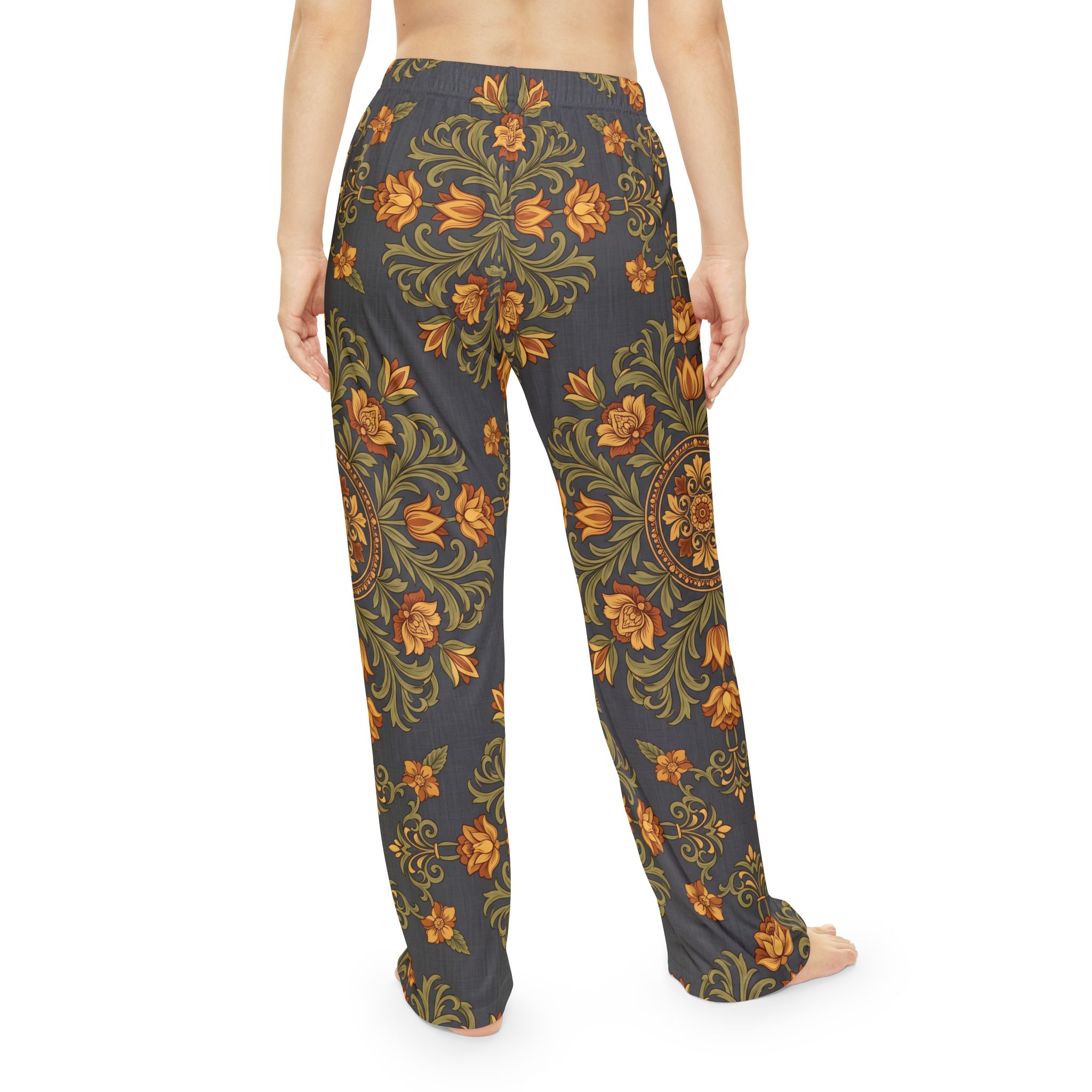
Picking a Print for a Room You’re In All Day
Something worth thinking about that never comes up in generic buying guides: you’ll see this print more than almost anything else you own, at close range, for months. A print that’s fun in a five-second product photo can get genuinely tiring by the fortieth wear. Three options worth knowing the difference between:
- Botanical Vine Stripe — a vertical stripe with vine detailing, reads calmer at a distance than a full floral, good if you want something that doesn’t announce itself in every video call background.
- Floral Damask — a denser, more formal-feeling repeat pattern, closer to upholstery-grade florals than a casual print, holds up well as a genuine daily-wear piece rather than feeling novelty.
- Wildflower Meadow — the loosest, most scattered floral of the three, best if you want something that still feels like “loungewear” rather than pants that could pass in public.
None of these is objectively the right answer — it depends on whether you want pants that disappear into the background of a video call (Botanical Vine Stripe), pants that feel a little more put-together on days you’re not on camera at all (Floral Damask), or pants that are unmistakably about comfort first (Wildflower Meadow).
The Waistband Test
A genuinely useful way to judge any pair of loungewear pants before buying: think about how you sit at your desk, not how you stand. Office trousers are designed to look right standing up and get uncomfortable within an hour of sitting. Loungewear pants should do the opposite — a soft, wide waistband that doesn’t dig in when you’re seated for hours is the actual functional requirement, and it’s the detail cheaper pajama-style pants usually skip in favor of a thin elastic that rolls and pinches by early afternoon.
Fabric Weight Changes More Than Comfort Level
A single pair of loungewear pants rarely works year-round the way people expect it to. Heavier, brushed-back fabrics feel warm and cozy in a cold home office through fall and winter but can feel genuinely uncomfortable — clingy, overly warm — once a room warms up in spring and summer, even indoors with air conditioning. Lighter jersey or cotton-blend loungewear breathes better for warmer months but won’t offer much against a cold floor or a chilly room in January. Most people who wear loungewear pants daily end up with at least two weights in rotation for this reason, the same way anyone would rotate seasonal clothing for temperature, even though loungewear rarely gets thought of that way.
Keeping a Print Looking New
Printed loungewear worn daily goes through far more wash cycles than an equivalent pair of jeans or trousers, since it’s typically washed after every one or two wears rather than every several. That accelerated laundry cycle is the main reason a printed pair can start looking faded or dull months before a plain pair would show equivalent wear. Washing in cold water, turning the pants inside out before washing, and air-drying instead of high-heat tumble drying all meaningfully extend how long a print stays vivid — none of it is complicated, but skipping all three is the single most common reason people feel like their loungewear “wore out” faster than expected, when really it faded faster than expected.
Cost Per Wear Is the Right Way to Think About Price
A pair of loungewear pants worn several times a week for a year gets worn far more than almost anything else in a closet — more than most work clothes, more than most weekend clothes. Judged against that actual usage rate rather than the sticker price alone, a well-made pair that holds its shape and color for a couple of years is usually the better value than a cheaper pair replaced twice as often, even before accounting for the second pair’s shipping and the hassle of reordering.
Sizing Loungewear Pants Correctly
Elastic and drawstring waistbands make loungewear more forgiving than fitted trousers, but they also make it easier to size incorrectly without realizing it until well into ownership. A waistband that’s too loose bunches and rolls under a shirt hem and needs constant readjusting through the day; one that’s too tight defeats the entire point of buying comfort-first pants in the first place. The most reliable check isn’t the waist measurement alone — it’s sitting down in them for several minutes before deciding, since a waistband that feels fine standing can dig in noticeably once seated, which is exactly the position these pants spend most of their life in.
Leg length matters more for loungewear than people expect too, since these pants are worn without shoes far more often than regular pants. Extra length that would be hemmed away on trousers just pools at the ankle here, which looks sloppier on camera during the brief moments a call shows more than the desk, and can be a genuine trip hazard walking around the house.
Coordinating With Whatever’s on Top
Since the pants themselves are rarely seen on camera, the actual coordination that matters is comfort-to-comfort, not color-matching to a video-call top nobody will see them next to. What does matter is not fighting two competing prints against each other when both are visible at once — around the house, answering a door, a video call where the framing happens to widen. A patterned lounge pant paired with a solid or very simple top avoids visual clutter more reliably than pairing two busy prints, which is the same basic styling rule that applies to any outfit, just with lower stakes since so little of it is usually on display at once.
When to Size Up Instead of Down
The general sizing advice for loungewear leans toward sizing down given the extra ease most cuts already include, but that’s not universal. Anyone planning to layer these under a robe regularly, or who runs cold and expects to wear a base layer or thicker socks underneath during colder months, is better off sticking with a true size or even sizing up slightly, since the relaxed cut that feels generous alone can feel tight once something else is layered underneath it. The right choice depends on how the pants will actually be worn day to day, not just how they fit tried on alone in a normal-temperature room.
Pockets Are Worth Checking For
Not every pair of loungewear pants includes real, usable pockets, and it’s an easy detail to miss when comparing options on a product photo alone. For anyone who wants to carry a phone around the house without a free hand, a pocket deep enough to hold it securely is worth checking for specifically before buying, rather than assuming — plenty of loungewear is styled with decorative or shallow pockets that look fine in a photo and don’t actually hold anything.
Frequently Asked Questions
Are loungewear pants too casual to wear outside the house?
For a quick errand — mail, trash, a package — most loungewear pants pass without a second look, especially in a solid or subtle print. For anything longer, they read more clearly as at-home wear, which is the point: they’re optimized for comfort during long stretches, not for public styling.
How many pairs do I actually need?
Two is the realistic minimum — one to wear, one in the wash — and three covers most people comfortably without over-buying. Rotating prints also matters less for practicality and more for not getting visually tired of the same pattern every single day.
Do loungewear pants run differently than regular pants sizing?
Most are cut with more ease through the hip and thigh than standard trousers, by design — if you’re between sizes, sizing down is usually safer than sizing up, since the intended fit is relaxed rather than fitted regardless of size.
Pairs well with something camera-ready up top: what to wear on video calls. Back to the full guide.